Your Doctor Said It Only Gets Worse.
Your Symptoms Say Something Else Entirely.
Two different conditions are being called one name, treated one way, and given one prognosis. Only one of them is the one you have.

You went in with urgency, leaks when you laughed, and three or four trips a night. They said overactive bladder and wrote you a prescription.
You took it. The urges eased a little. Then they came back.
So you went back. They raised the dose. Still there. They tried a different one — oxybutynin to tolterodine, tolterodine to solifenacin. Same result.
And eventually somebody said the sentence you have not been able to put down since.
“This is just something you will have to live with.”
You have carried that sentence further than anyone realises.
Into how you plan a car journey. Into which chair you take. Into what you quietly decline for eighteen months from now, because of what you assume you will be by then.
It is not the leaks that keep you awake at three in the morning. It is the arithmetic.
But it is your bladder. It is just not the part they were treating.
Two Different Conditions Are Wearing One Name
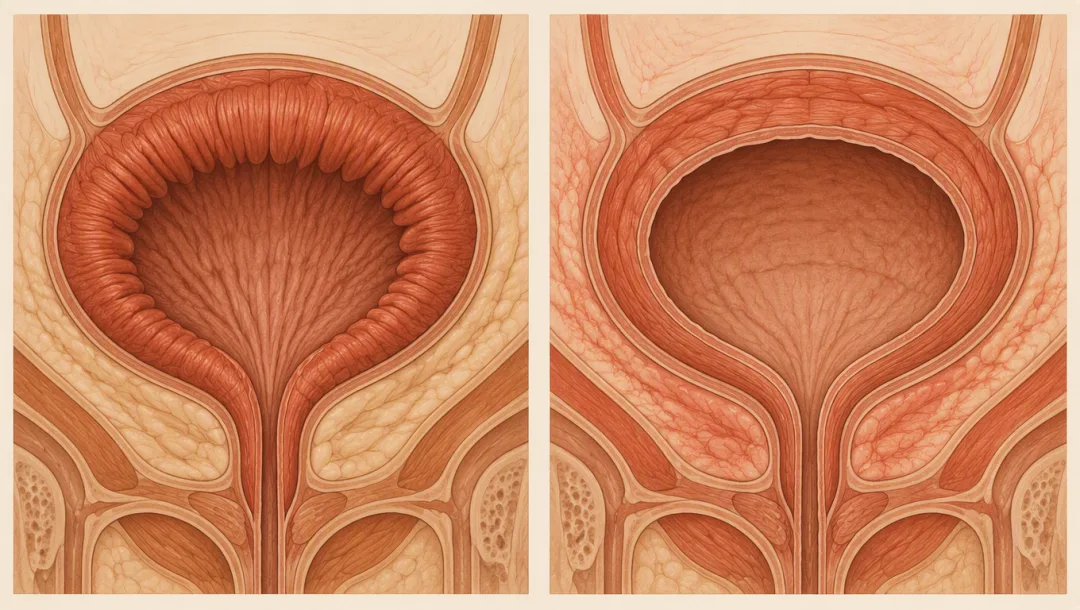
“Overactive bladder” is not a diagnosis. It is a description of a symptom, and at least two entirely separate things produce it.
This is the most important distinction you will read today. Once you have it, everything about the last few years — why the first pill half-worked, why the dose kept climbing, why your scans came back normal — suddenly makes sense.
| THE MUSCLE KIND | THE HORMONE KIND |
| The detrusor muscle contracts when it should not. The signal misfires. | The muscle is behaving normally. The tissue it sits in has changed. |
| The tissue itself is fine. | The lining has thinned and turned reactive, so an ordinary signal lands on a surface that can no longer absorb it. |
| Every drug on the standard ladder aims here — oxybutynin (Ditropan), tolterodine (Detrol), solifenacin (Vesicare), mirabegron (Myrbetriq). | Not one of them touches this. They quiet a muscle that was never the problem. |
| Bladder only. | Bladder, hair and sleep together, because the same receptor sits in all three tissues. |
| “It will only get worse” is a sound forecast. Muscles do not spontaneously get stronger with age. | That forecast was never written about you. |
Yet the standard treatment is the same for both. That is the gap.
The Thirty-Second Test That Tells You Which One You Have
You do not need a cystoscopy to sort this out. The hormone kind gives itself away, because the tissue it acts on is not only in your bladder.
Count the ones that are true for you.
- The drain. There is more hair in it than there was two years ago, and your part line has widened.
- The clock. You wake around three — and you were waking before the bathroom trips got bad enough to explain it.
- The calendar. The urgency, the shedding and the broken sleep all started inside the same eighteen months.
- The ladder. At least one drug worked for a while and then stopped, or needed a higher dose to keep working.
SCORE OF TWO OR MORE
The pill you were handed was never aimed at your condition. It was aimed at the other one — and the forecast that came with it was aimed at the other one too.
The Prognosis Was Written About The Other Condition
Here is the part nobody says out loud.
“It will only get worse” is a sound forecast — for a failing muscle. If the muscle is the problem, the curve genuinely does point one way.
That forecast was handed to you off a label. Not off an examination of what is driving your symptoms.
A prognosis is a prediction about a cause. Change the cause you are treating and you are not on that curve any more.
You have not been failing your treatment for years. You have been succeeding, perfectly, at the treatment for a condition you do not have.
What Actually Sits Underneath
As estrogen falls through the forties and fifties, it stops holding back an enzyme called 5-alpha reductase.
That enzyme converts your own testosterone into a far more aggressive hormone: dihydrotestosterone. DHT.
Men know DHT as the balding hormone. In women it does not politely restrict itself to the scalp.
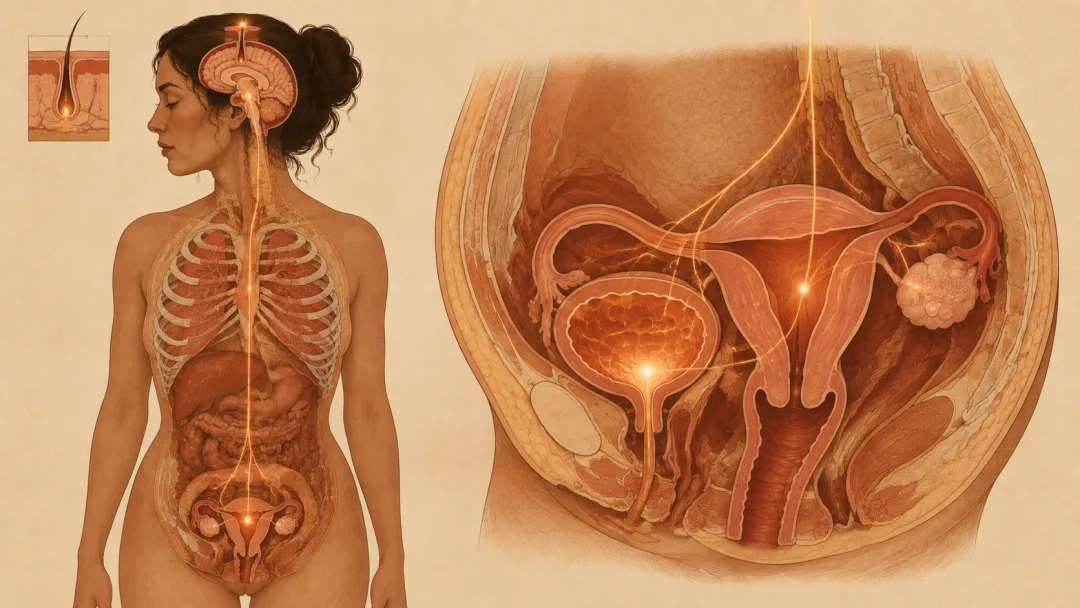
DHT acts wherever the tissue carries receptors for it — the lining of the bladder, the root of every hair follicle, and the pathways that govern deep sleep.
Which is why the symptoms arrive as a set. Not three unlucky coincidences of aging — one hormone shift with three visible exits.
An anticholinergic forces the bladder muscle to stop contracting. It does not touch the enzyme. It does not lower DHT.
It never goes near the root.
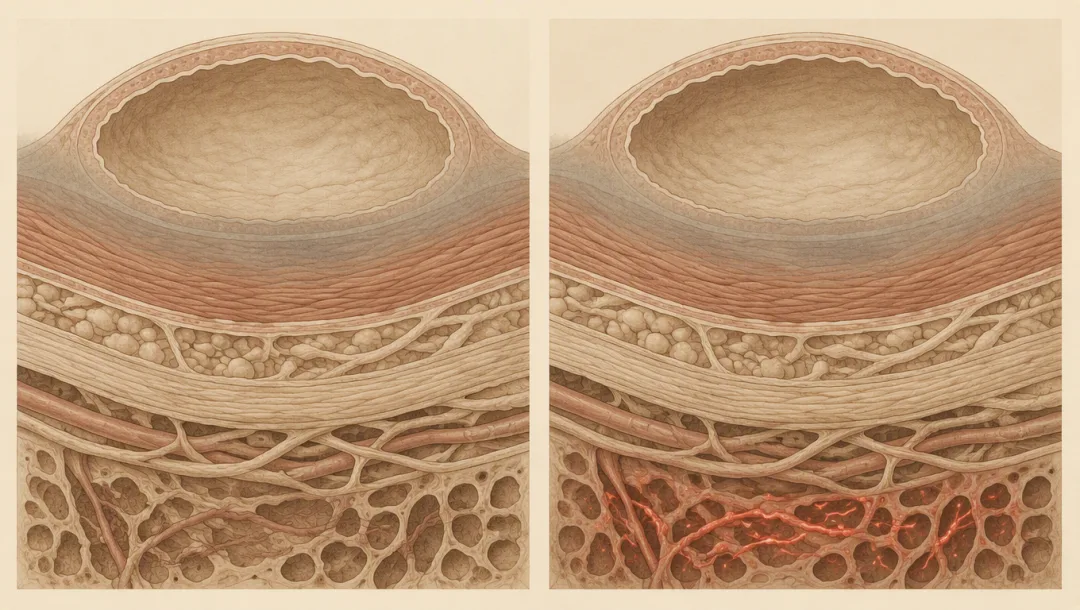
So the muscle goes quiet, the diary looks better, and you are told it is working. The enzyme keeps converting the entire time.
That is why the urges break through again a year later. That is why the dose goes from 5mg to 10mg to 15mg. And that is why your hair kept thinning the whole time you were taking something for your bladder.
Everything You Already Tried, And Why None Of It Was Wasted
- Kegels and pelvic floor therapy strengthen the muscle around the problem. They do not lower DHT.
- Pads and bladder training manage the consequence. Useful, and not a cause.
- Cranberry and cutting caffeine reduce irritation on top. The conversion continues underneath.
- Shampoos, serums and collagen work on the strand. The follicle is being choked at the root.
None of it is your fault, and none of it was wasted effort. Every one of those things is a reasonable answer to the wrong question.
See What Reaches The Root(You can review everything before you order)
What Women In One Austrian Valley Do Differently
In Styria, in southern Austria, pumpkin seeds have been cold-pressed into a dark green oil for roughly three hundred years, and the women there take it daily.
Bladder and thinning-hair complaints among those farming families run markedly lower than the national average.

It is paired here with saw palmetto, the botanical studied most often for exactly this enzyme — the one that converts testosterone into DHT.
Quiet the enzyme and you are working upstream of all three symptoms instead of downstream of one.
Two Conditions Decide Whether A Pumpkin Seed Oil Does Anything At All
- Cold-pressed, not heat-extracted. Heat destroys the active fraction. Most supermarket oil is pressed hot because it is cheaper.
- A real dose, standardised. A token amount of oil in a capsule gives the enzyme nothing to compete with.

How It Works, In Three Steps
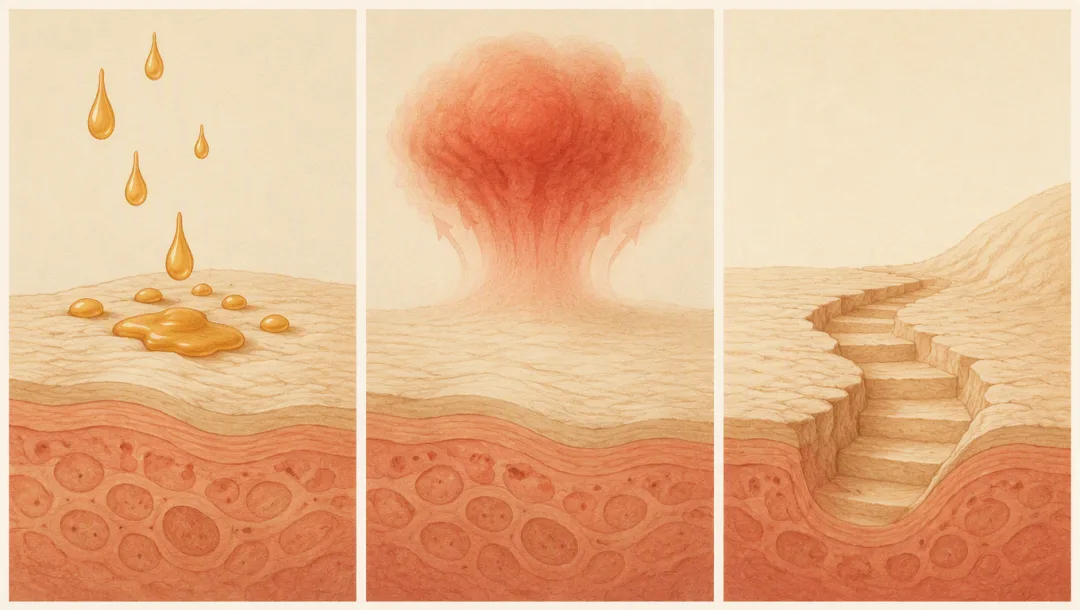
- The actives reach the tissue. Saw palmetto works against 5-alpha reductase where it is active — bladder lining, follicle, sleep pathways.
- Irritation settles. With less DHT acting on it, the bladder lining is under less constant provocation and the follicle is no longer being choked.
- The curve changes direction. Tissue that is no longer under hormonal pressure stops deteriorating on the schedule you were promised.
What Has Actually Been Measured
A prognosis is an argument about direction. The only thing that can settle an argument about direction is a measurement taken more than once.
THE BLADDER SCORE MOVED — THEN MOVED AGAIN
In a published trial of pumpkin seed oil, overactive-bladder symptom scores were significantly improved at six weeks, and improved further at twelve.1 Two readings, both travelling the same way. That is the shape a one-way forecast says is not on the table.
THE FOLLICLE TRIAL WAS RUN IN MEN — AND WE WILL SAY SO
A twenty-four-week placebo-controlled trial of pumpkin seed oil recorded significantly more hair growth than placebo.2 Those participants were men. What carries across to a woman is the enzyme, which is the same enzyme, not a female result we are quietly borrowing.
Neither of those is a promise about you. They are the reason the forecast you were handed was never the only one available.
What To Look For On The Label
Getting the doses right is not a kitchen project. The formulation women in this situation keep landing on is Biolgical Pumpkin Seed Oil Softgels.

- 3,000mg cold-pressed pumpkin seed oil per daily serving
- 300mg saw palmetto extract, alongside the oil rather than instead of it
- 2 softgels a day — no routine to build
- Non-GMO and lab-tested. Free from soy, dairy, gluten and tree nuts.
Most women who report a change describe it starting in the second or third week — nights first, then the drain.
Get Up To 70% Off Biolgical(You can review everything before you order)
Thirty Days, Money Back, No Questions Asked
Keep a simple diary for four weeks — nights up, strands in the drain, part width. If those three numbers have not moved, send it back and get every penny returned.
- 30-day money-back guarantee
- Free shipping
- 2 softgels daily, no routine to build
The Four Questions Women Ask Here
“I am already on oxybutynin. Do I stop?”
No. Do not stop or change a prescribed medication on the strength of an article. This is taken
alongside what you are already on, and any change to the prescription is a conversation with the
person who wrote it.
“So was my doctor wrong?”
Not about the muscle. He gave you the standard forecast that goes with the standard diagnosis, and
for the condition that diagnosis describes the forecast is sound. The gap is that one name is
doing duty for two conditions, and nothing in the standard workup separates them.
“What if I scored zero or one on the test?”
Then the hormone kind probably is not what you are dealing with, and the ladder you are on may
well be aimed correctly. We would rather tell you that than sell you something pointed at the
wrong tissue.
“How long before I know either way?”
Give it eight weeks and watch three numbers rather than one — nights up, strands in the
drain, part width.
Two Roads From Here
| REFILL THE PRESCRIPTION | EIGHT WEEKS ON THE SHIFT UNDERNEATH |
| Accept the next dose increase when the urges break through. | Keep everything else you are doing. Change nothing you were told to keep. |
| Take the forecast at face value. | Watch three numbers instead of one. |
| The enzyme keeps converting, and the forecast goes on being right for the one reason nobody examined. | If the three numbers have not moved, you send it back and it cost you nothing. |
The sentence you were given was a prediction, not a diagnosis. A prediction is only ever as good as the cause it was written about.
(You can review everything before you order)