I Spent 20 Years Telling Women Their Thinning Hair and Their Leaks Were Just Their Age. I Was Wrong.
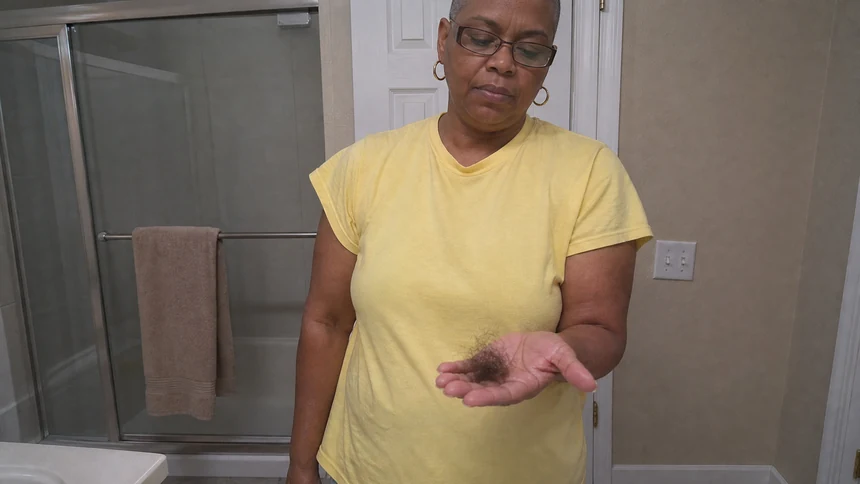
If you have already worked out on your own that “age” was never an explanation, you were right, and I was one of the people saying it.
Twenty years in women's health.
Here is what that one word is actually doing to the women who hear it — and why nobody ever went looking underneath it.

There is a patient I still think about. Carol. 58 years old. She ran the office at a school district for twenty-two years.
She came into my office on a Tuesday afternoon and told me, very matter-of-factly, that she had stopped bringing it up.
Not because it had got better.
Because she had run out of people to bring it up to.
She had been raising the same three things for eleven years — the shedding, the leaking, the 3am waking.
Every time she raised them, they were handed back to her as one word: it was her age, and there was nothing to be done about her age.
So she stopped raising the hair.
Then she stopped raising the sleep.
At her last appointment she was told she would live with this for the rest of her life — and that most women her age simply do, quietly, without making a fuss about it.
She said thank you in the room.
She cried in the parking lot.
She told me this without tears.
Without anger.
In the tone you use when describing something you have already made peace with.
I gave her the usual answers that day.
Drink less in the evening.
Try the pelvic floor exercises again.
A lot of women find this settles once the change is fully behind them.
And then she left, and I sat there with her chart open, and for the first time in years I felt genuinely bothered.
Not by Carol specifically.
By how many Carols there had been.
And by a question I had never seriously asked myself: Was I actually right that this was simply her age?
I spent the next six months finding out.
The answer changed how I practice entirely.
Your Body Is Not Old. It Is Unprotected.
The real reason all three arrived together — and why the word “age” was the answer that stopped anyone looking
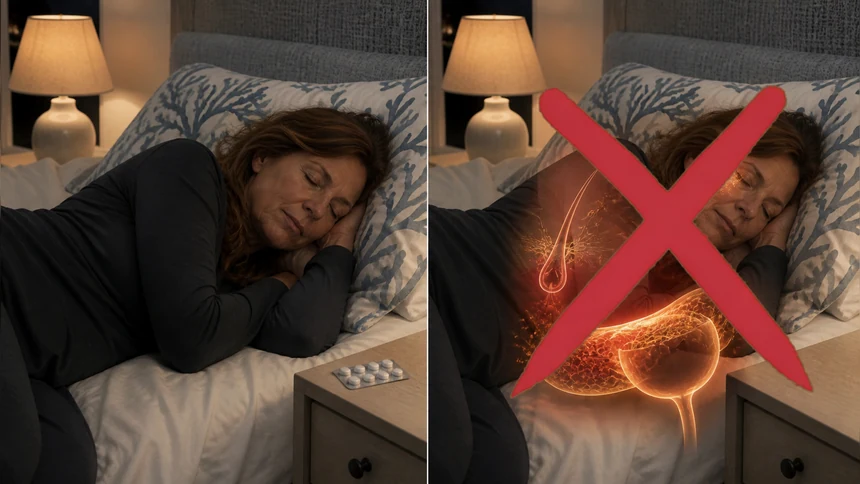
“Estrogen does not only run your cycle — it is the brake on a hormone called DHT.
After menopause, the brake comes off.
DHT reaches the follicle and shrinks it.
It reaches the bladder wall and thins it.
And it is why you are awake at 3am.”
So the hair thins on a scalp that has not otherwise changed.
And the bladder starts signalling long before it is full.
The Estrogen Gap Has Been Documented For Decades
This is not a fringe theory.
The link between the estrogen drop and DHT is documented in the endocrinology literature.
The body is short of the one hormone that kept DHT in check.
So DHT circulates with nothing holding it back — the same pathway any dermatologist would name in a man losing his hair at thirty.
And it reaches tissue that had been protected for forty years.
The three symptoms everyone treats separately are one shortage, showing up in three places.
The Enzyme Is What Switches It On
5-alpha-reductase is the other half of the picture: it is the enzyme that converts your own testosterone into DHT in the first place.
So What Is Actually Doing This
It is not your age turning on you for no reason.
It is a hormone that lost its brake.
Your body is not old.
It is unprotected.
And what is unprotected can be protected again.
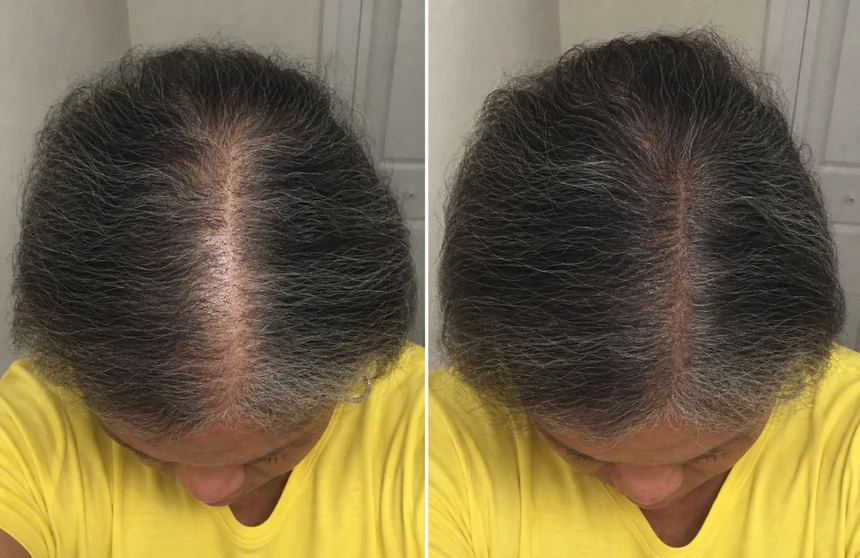
“I had never once heard the word DHT. When I understood what was actually happening — that it wasn't my age, it was one hormone falling and another one running loose — I cried. Not from sadness.
From relief.
Finally something that made sense.”
Ruth P., 61, Denver, CO✓ Verified Biolgical customer
Why Every Answer You Were Given Failed

Biotin and collagen feed a follicle that was never short of protein.
They do not touch the hormone that is shrinking it.
They are treating the hair, not the reason the hair is going.
Bladder-control pills quiet the muscle while you take them, but they do not lower one unit of DHT.
Nobody disputes that they help.
They just do not reach the root cause — so the moment you stop, it returns exactly as it was, and the answer is a stronger one.
That is not a treatment plan.
That is a holding pattern, and every year in it is another year nobody went looking.
Cutting fluids after six removes what provokes the bladder.
A less-provoked unprotected bladder is still an unprotected bladder.
Hiding It Is Not a Treatment Either
Pads and partings. A liner every day, changed four times, is 1,460 of them a year, indefinitely. She buys them quietly.
The parting hidden with powder, a scarf kept in the car, a seat chosen near the door. This is not a solution.
This is a subscription to a problem that does not have to be permanent.
What Puts the Brake Back On
Six months in the literature kept pointing at the same short list. Each one addresses a different part of the Estrogen Gap.
Together they give the body back the brake it lost, so the follicle and the bladder stop being reached at all.

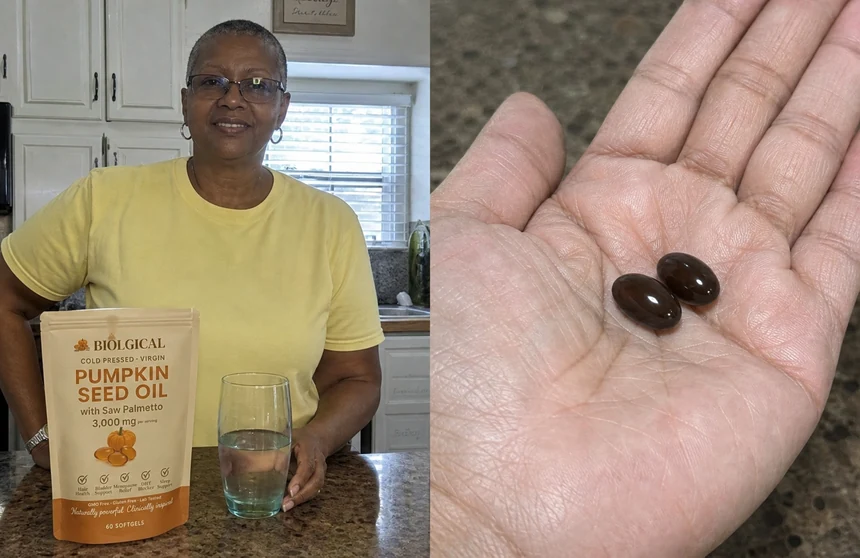
Cold-Pressed Pumpkin Seed Oil, 3,000 mg — Quiets the Enzyme
A cold-pressed oil at a full 3,000 mg — the dose used in the published work, not a dusting of it, taken from the inside, where the enzyme actually runs.
This is the one that addresses the conversion itself rather than what it causes.
Saw Palmetto, 300 mg — Blocks It At The Follicle
The berry extract that sits in the same pathway as the oil, aimed at the other end of it.
Quieting the enzyme matters; blocking what it already made, at the receptor it was heading for, matters just as much, which is why this sits beside the pumpkin seed oil rather than behind it.
Why One Active Never Finishes The Job
Most hair supplements do one job.
Quiet the enzyme and you stop what is coming, but you leave everything it has already made still circulating.
Block it at the follicle and you stop what has arrived, while the enzyme keeps producing more behind it.
The Estrogen Gap fails at two points, not one.
- The brake is gone, so the enzyme runs unchecked
- What it has already made keeps reaching the follicle
What Women Tell Me After 8 Weeks
It is not a bladder drug and it is not hormone therapy.
The two actives are a full 3,000 mg of cold-pressed pumpkin seed oil and 300 mg of saw palmetto, and the shedding is the first thing to settle — which is exactly what the 30-day window is there to let you see.
*Doses shown are per two-softgel daily serving. Individual results vary.
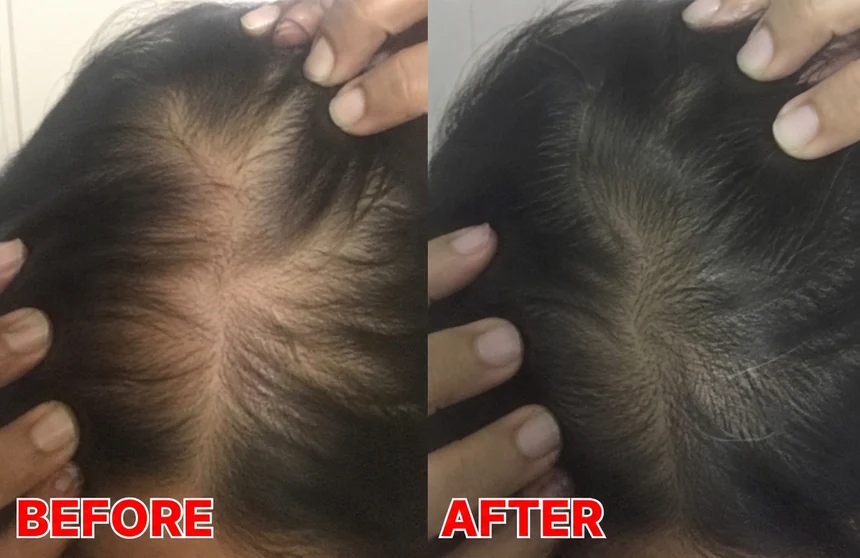
“Week three I noticed I wasn't counting what came out in the shower drain any more. I just washed my hair and got out. Didn't think about it once.
I sat in the car outside my daughter's for a moment when I arrived and thought, when did I stop doing that?
Four years ago.”
Susan B., 62, Seattle, WA✓ Verified
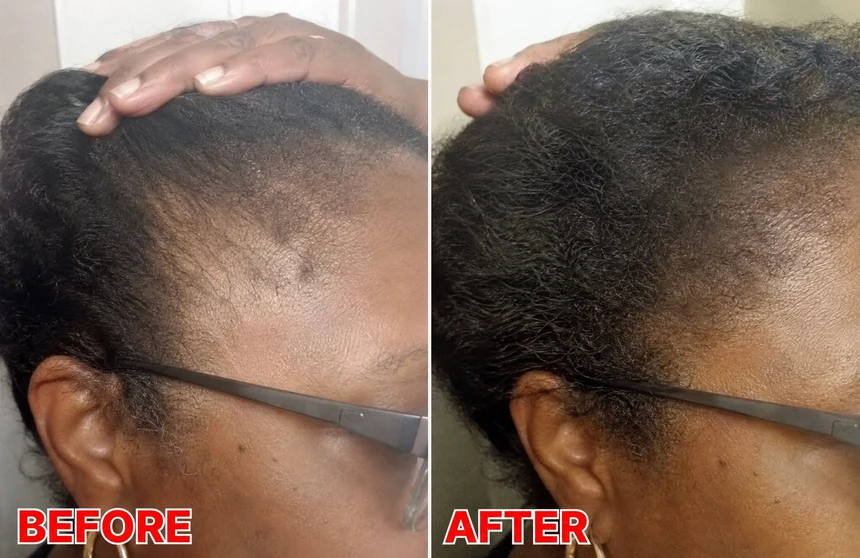
“If I felt the urge it was already too late. It's like there was no warning. I bought these as a last ditch effort.
After six weeks I am able to lead a normal life.
I stopped buying the liners.
That sounds like a small thing and it is not a small thing.”
Renee T., 58, Nashville, TN✓ Verified
“I wore my hair up to my granddaughter's school play because I could not stand one more person telling me it was just my age.
I drove home and cried in my car.
Eight months later I have stopped having that conversation.”
Denise K., 59, Columbus, OH✓ Verified
What to Expect, and When
The most important thing I tell women before they begin: this is a hormone shift being corrected, not a symptom being silenced.
You are restoring a brake. Results accumulate over weeks, which is why the first eight weeks matter.
The groundwork is being laid.
Most women notice little yet, which is normal.
The enzyme is being quieted in a body that has run without a brake on it for years.
Some notice they are up one fewer time in the night.
The levels are shifting.
The first measurable shift arrives.
Women report losing fewer hairs when they wash it.
The urge starts arriving with some warning again.
Several describe getting through an evening without planning around a bathroom for the first time in years.
“I just went out,” one woman told me.
“I didn't think about it.”
The symptoms stop dominating daily life.
The shedding becomes occasional rather than constant.
Women return to things they had quietly abandoned: a long drive, a swim, a dark top without checking the shoulders.
Sleep consolidates.
The 3am waking stops being every night and starts being sometimes.
The most consistent thing women say is the same thing, phrased different ways: they stopped planning their day around it.
Not managed it.
Not worked around it.
Stopped thinking about it entirely.
For anyone who has spent years planning her life around this, that single shift is not a small thing.
So, What Are Your Actual Options?
I want to be direct. There are three realistic paths from here, and only one of them addresses the problem.
Left alone, the brake does not come back on by itself.
The follicle keeps shrinking under the same hormone, and the three compound rather than resolve.
The sentence waiting at the end of that path is “you will live with this for the rest of your life” — said in under ten seconds, in a room you paid to sit in — and you accept it having never once been offered the thing underneath.
Why a Stronger Pill Is Not a Better One
The medications themselves are not in dispute.
Nobody disputes that they help, and they quiet the muscle while you take them.
But they do not lower one unit of DHT, do not slow the enzyme that makes it, and do not put the brake back on.
So you stop, everything returns, and the answer on offer is a stronger one.
And the anticholinergic class carries its own long-term questions, which is a second conversation nobody starts either.
The third path is the only one that works at both points in the pathway at once: the enzyme that runs unchecked once the brake is gone, and the DHT it has already made still reaching the follicle
The Formula I Now Recommend
I am not in the habit of recommending specific commercial products. My clinical recommendations are based on research, not relationships.
But after reviewing the available formulas against the published literature, there is one I now recommend consistently to my patients.
It is called Biolgical . Two softgels a day. No prescription and no hormones.
It is the only one I have found that puts a full 3,000 mg of cold-pressed pumpkin seed oil and 300 mg of saw palmetto in the same softgel, instead of asking you to buy them separately and hope the doses line up.
It is backed by a 30-day money-back guarantee, which matters: the shedding is the first thing to settle, and thirty days is long enough to see whether it does.


What Happened to Carol
Carol came back seven weeks later.
She had not filled the new script.
She had her hair down in my office, which she had not done in front of me in four years.
She said: “I felt like a woman who had been given an answer. Not a woman who was being managed.”
She asked why nobody had told her this earlier.
I gave her the honest answer: there is no money in it.
No company funds awareness of a hormone shift you can address with a seed oil.
The research exists — it has for years — but it lives in journals nobody hands you at an appointment, and it never once came up in the room where you were told it was your age.
So women go on filling the next script.
Buying the liners.
Waking at 3am and counting what came out in the drain.
Watching their lives get smaller, one abandoned thing at a time, because they have been told this is simply what a woman's body does after fifty.
It is not what your age feels like.
It is what a missing brake feels like.
And a missing brake, given the right materials, can be put back on.


